
Cataract surgery with advanced lens implants in Najaf
Cataract surgery with a lens chosen for your eye and your daily life: EDOF IOL, Multifocal IOL and Toric IOL. With Dr. Karrar Ali Altufeili in Kufa, Najaf.
- Anaesthesia
- Usually drops
- Hospital stay
- None, same day
- The lens
- Lasts for life
 With cataract After surgery
 Drag the line to compare. An approximate simulation of what many patients describe: haze, yellowed colours and glare. Symptoms vary from person to person.
What is a cataract?
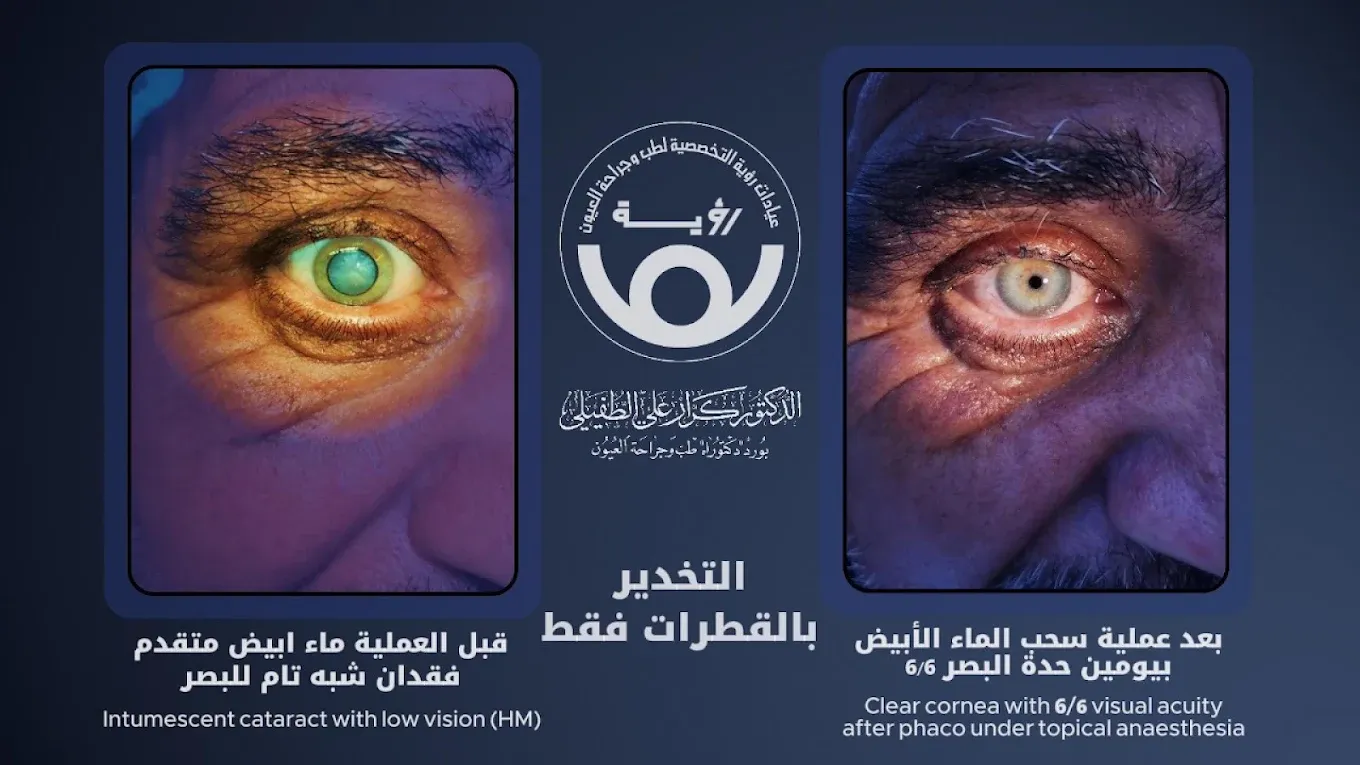
A cataract is a gradual clouding of the eye’s natural lens. Age is the most common cause; diabetes, long-term steroid use and eye injury can also contribute.
Common symptoms: cloudiness that new glasses do not fix, glare from lights especially when driving at night, faded colours, and frequent changes in prescription.
How the surgery works
- Anaesthesia: usually drops only, with more if needed.
- Small incision: a tiny opening at the edge of the cornea, usually self-sealing.
- Phacoemulsification: the cloudy lens is broken up with ultrasound and removed.
- Lens implant: a foldable artificial lens is placed in the natural lens capsule, where it stays for life.
One eye is operated on at a time; the second is scheduled once the first has recovered.
Choosing your lens
There is no single “best lens”. The right one depends on the health of your cornea and retina, how much astigmatism you have, your daily needs, and how you feel about possible light effects.
Compare lens options
Monofocal lens
The standard lens: sharp, high-quality vision at one distance, usually far.
Often suits
- Best contrast and quality for distance
- Retinal, macular disease or glaucoma
- You don't mind reading glasses
Worth knowing
- You will usually need glasses for reading and phone
- An excellent, safe choice for many patients
Extended depth of focus (EDOF) lens
Extends clear vision from far to intermediate, with fewer light effects than multifocals.
Often suits
- Driving, computer and dashboard
- Fewer glasses with fewer light effects
Worth knowing
- You may need glasses for very small print
- Needs a generally healthy eye
Multifocal / trifocal lens
Aims for far, intermediate and near vision — the best chance of reducing glasses.
Often suits
- Maximum independence from glasses
- Healthy retina and macula
- Realistic expectations and patience to adapt
Worth knowing
- Halos and glare at night, usually easing with time
- Slightly reduced contrast
- May not suit heavy night drivers
Each of these lenses comes in a toric version that corrects astigmatism at the same time. Power and axis are set precisely from pre-operative measurements.
An approximate comparison for illustration. Real results depend on your eye and the specific lens; the doctor will choose with you.
Complex cases
Some eyes need special techniques: a very advanced cataract, weak lens zonules, no capsule support, or a previous implant that has moved. Dr. Karrar performs:
- Complicated cataract surgery
- SFIOL (scleral-fixated IOL)
- Yamane technique
With SFIOL and the Yamane technique the lens is fixed to the wall of the eye (the sclera) when there is no capsule to hold it. Your examination shows whether you need either.
Tests before surgery
- Visual acuity, refraction and slit-lamp examination
- Optical biometry to calculate the lens power precisely
- Corneal curvature and astigmatism measurement
- Retina and macula check; an OCT scan may be requested
- Eye pressure and a review of general health and medicines such as diabetes and blood thinners
Recovery
- Vision usually improves within days and stabilises over a few weeks.
- Use your drops as prescribed, usually for several weeks.
- Wear the eye shield at night for the period advised, and do not rub the eye.
- Keep water out of the eye and avoid very heavy lifting for the first days.
- Typical follow-up: next day, one week, one month; final glasses (if needed) once vision is stable.
Possible risks
Cataract surgery is one of the most successful operations in medicine, but no surgery is risk-free:
- Inflammation or a temporary rise in eye pressure
- Temporary swelling of the cornea or macula
- Later clouding of the posterior capsule, treated with YAG laser
- A small residual prescription needing glasses
- Halos or glare, more common with multifocal lenses
- Rarely: infection inside the eye, retinal detachment, or lens dislocation
Cataract and lens questions
Where can I have cataract surgery in Najaf with Dr. Karrar Altufeili?
Start with a cataract and lens-options consultation at Vision Specialized Eye Clinics, next to the Tax Office in Kufa, Najaf. Call or WhatsApp 0772 115 0391.
When should cataract surgery be done?
When reduced vision starts to affect daily life — reading, driving, work — or when the doctor sees a medical reason. There is no need to wait for a cataract to “ripen”.
Does it hurt, and how long does it take?
It is usually done under anaesthetic drops; most patients feel only light pressure. The surgery itself typically takes 15–30 minutes and you go home the same day.
What is a premium IOL?
Lens implants that do more than basic distance correction: toric lenses correct astigmatism, EDOF lenses extend the range of focus, and multifocal lenses aim to give distance, intermediate and near vision. Each has trade-offs, and a standard monofocal lens remains an excellent choice for many patients.
Will I be free of glasses after surgery?
It depends on the lens and the health of your eye. Multifocal and EDOF lenses can greatly reduce the need for glasses, but complete independence cannot be guaranteed for every patient.
Can a cataract come back?
The cataract itself does not return, but the capsule behind the lens can become cloudy months or years later. This is treated quickly in clinic with a YAG laser.
Medical references
Choosing a lens starts with an examination
Precise measurements, the health of your retina and your lifestyle decide which lens suits you.